
Elisabeth Hierling
Burgerweeshuis Orphanage,
Amsterdam, Netherlands, 1820
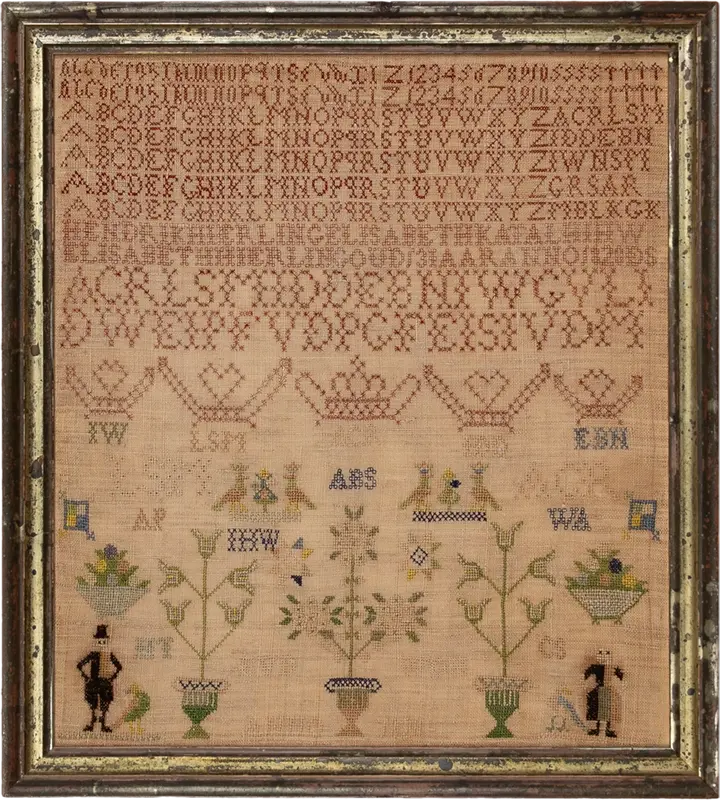
We are pleased to offer this interesting and very finely stitched Dutch sampler made at the Burgerweeshuis Orphanage - the Public Orphanage - which was founded in 1520 in Amsterdam. It was initially located across from Saint Lucien Monastery and in the 1580s was relocated to Kalverstraat where it remained for 380 years. The number of orphans housed and educated there grew quickly in the early years; the population in the 1620s was about 900.
As was the case in English orphanages and institutions, girls received instruction in needlework as part of their preparation for work as adults. The samplers made at Burgerweeshuis indicate the extremely fine work that girls learned while living there. Elisabeth’s lettering is very delicate, with alphabets and initials at the top. A line of inscription regarding her parents, worked in extremely delicate four-sided stitch, follows the alphabets and the next line reads, “ELISABETH HIERLING OUD 13 IAAR ANNO 1820” indicating that she was 13 years old when she made the sampler in 1820.
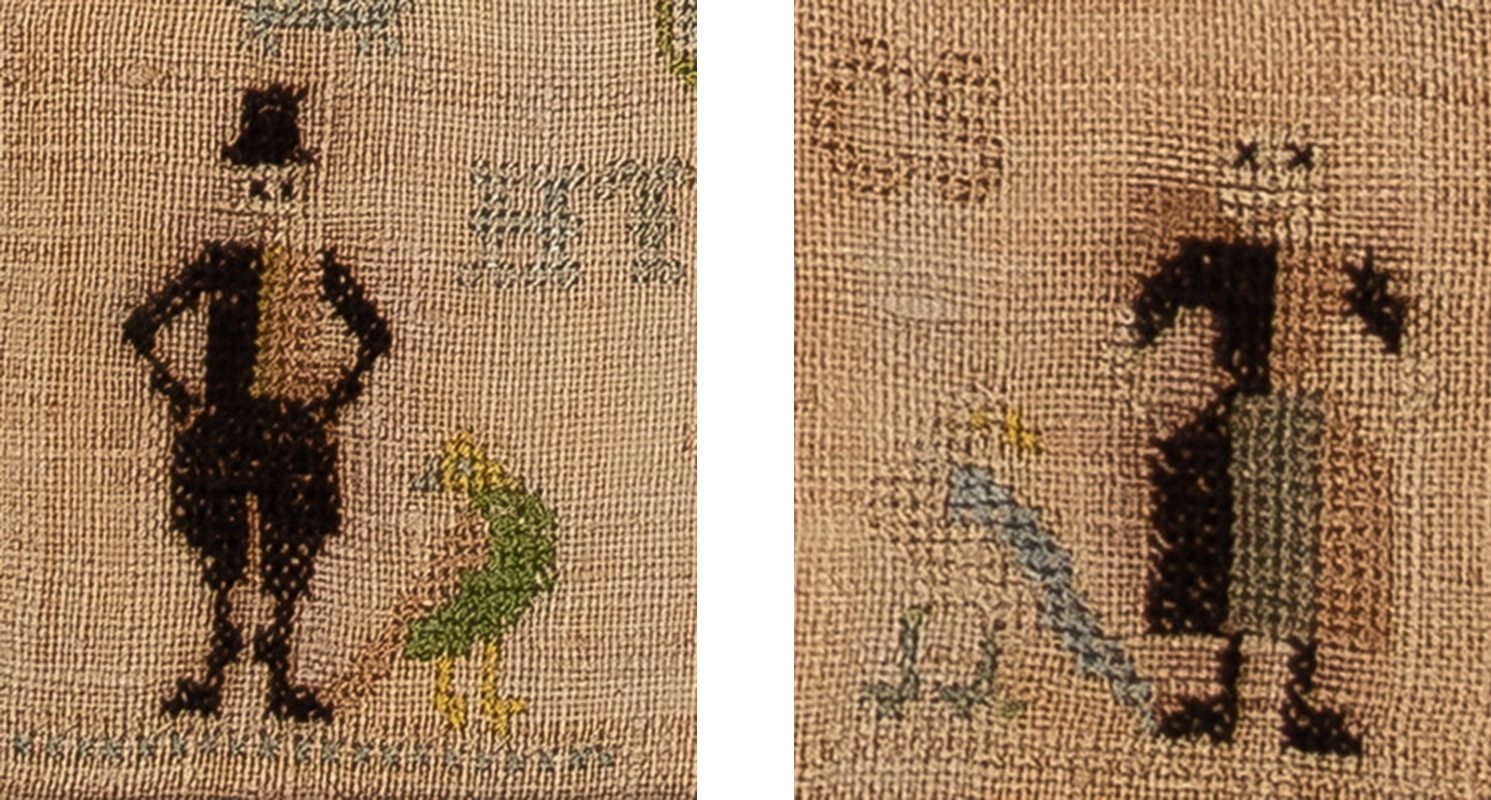
Of great interest on Elisabeth’s sampler are the two little figures in the lower corners. They are depicted in the precise uniforms that were unique to the girls and boys of the Burgerweeshuis Orphanage and had been worn by them for centuries.
There are many initials on the sampler - on the rows with alphabets, filling the two largest rows of lettering, underneath the crowns and scattered throughout. These would have been the initials of Elisabeth’s teachers and other female employees, such as the “linen mother.”
Elisabeth’s father, Hendrik, was born in 1772 and her mother, Elisabeth, was born in 1776. Our samplermaker, Elisabeth, was born on April 29, 1807. Her father died in 1813 and her mother died in 1815. She would have entered the orphanage some time after that.
On May 11, 1842, Elisabeth, who was working as a servant, married Willem van Andel, an office worker, and they had at least one child, a daughter, Christina.
Information about the samplermaker and her family was provided by Margriet Hogue, the highly regarded scholar and collector of Dutch samplers.
We previously owned another Burgerweeshuis Orphanage sampler, made in 1879, and we know of a handful of others. A sampler made there by Maria Helena Bernhardi in 1883 is now in the Centraal Museum in Utrecht and published in Over merklappen gesproken by M. G. A. Schipper-van Lottum (Amsterdam, 1980), figure 207. The Metropolitan Museum and the Cleveland Museum of Art also have samplers made at this orphanage in their collections.
The Burgerweeshuis Orphanage remained in operation at that location until 1960 when it was moved to modern quarters. The Kalverstraat building was renovated and reopened in 1975 as the Amsterdam Museum. Parts of the building remain just as they were when the orphans lived there.
The sampler was worked in silk on linen and is in excellent condition with some very slight darkening to the linen. It has been conservation mounted and is in a 19th century gold leaf frame.