
Vivienne I. Patrick
Sacramento, Sacramento County
California, 1871
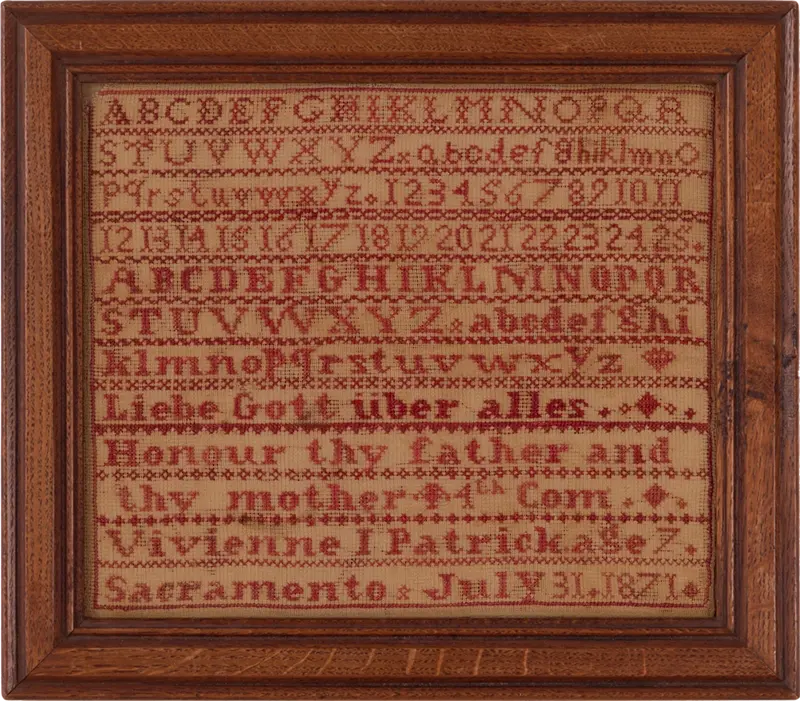
As the westward movement took hold, many American families left the comfort and security of the East and became pioneers, settling in territories throughout the Midwest and ultimately in California. They were joined by immigrants from many parts of the world, including, of course, Europe. Many settled in Sacramento, which is the oldest town in California, first established in 1839 as Sutter’s Fort and then laid out by John Sutter Jr. in 1848, following the discovery of gold at Sutter’s Creek. The population just about doubled between 1850, when about 6,800 people lived there, and 1860, when the population was about 13,800.
Just as schoolgirls back East had made samplers for centuries, the tradition continued, although to a much lesser degree, in California. There are only a handful of documented California samplers known to have been made in the schoolgirl tradition and these were made between the late 1850s and the late 1870s.
We are pleased to offer this example, made in 1871 by 7-year-old Vivienne Ingles Patrick, who was born in Wisconsin on February 21, 1864. She was the daughter of William Patrick (1829-1881) and his wife, Clara Angeline (Belknap) Patrick (1839-1920). Both William and Clara were born in New England; the Belknap family had roots that extended back to Abraham Belknap who emigrated with his wife, Mary, circa 1634, settling in Massachusetts.
William and Clara married in 1861 and were initially living in Wisconsin where several of their children were born. The western progress of the family continued and by 1869 they were living in Yolo, California, northwest of Sacramento. The 1870 census records the family in Yolo, with William listed as a farmer; Vivienne was age 6. The family then removed to Sacramento where they remained for many years, and their descendants lived there for generations.
William and Clara must have enrolled Vivienne in school soon after they arrived there, as her sampler is signed, “Vivienne I Patrick, age 7, Sacramento, July 3, 1871.” Above that, she stitched, “Honour thy father and thy mother 4th Com,” and the line above that reads, in German, “Liebe Gott uber alles” – “Love God above all else.”
Knowing that neither the Patrick or Belknap families were of German ancestry, we found it interesting that Vivienne used German language on her sampler. We have concluded that she very likely attended the German School, which was established in Sacramento in 1854, well documented in History of Sacramento by Thompson & West, 1880. One of the other known California samplers was made in 1869 at the German School, as the stitched inscription of that sampler indicates.
Returning to Vivienne, the 1880 census recorded the family living on O Street in Sacramento, with William listed as a fruit peddler. Notably, Vivienne, age 16, worked as a milliner, using the needleworking skills that she learned beginning at age 7. On Christmas Day, 1886, she married Phillip Edward Hammill (1858-1938) and they had two daughters and one son. Phillip was a blacksmith, operating his own smithy for many years. When he died in 1938, a fine obituary was published in The Press-Tribune of Roseville, part of the Sacramento area, stating that he had been, “Extremely friendly in his manners and always interested in civic affairs [he] became prominent in municipal and fraternal affairs locally.” Vivienne died in 1945 and is buried in Sacramento’s Odd Fellows Cemetery along with her husband.
The sampler was worked in linen on linen and is in excellent condition, with very minor loss to the linen in one corner. It has been conservation mounted and is in a late 19th century oak frame.