
MCT
Nuremberg, Germany, 1678
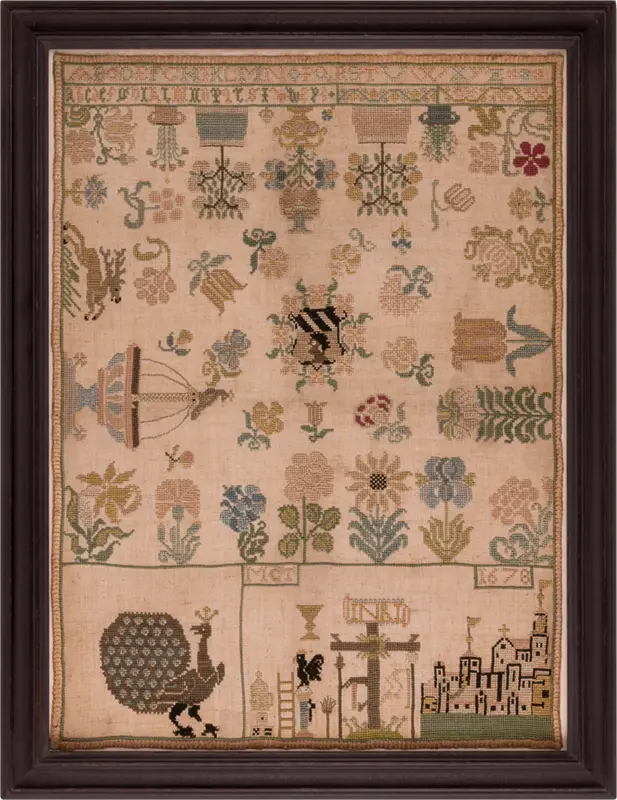
This sampler is part of a highly significant and interesting group of samplers exhibiting sophisticated composition, patterns, motifs and unusually excellent needlework. The samplers were made in the German city of Nuremberg, from 1650 through to the 1770s.
We turned to Tricia Wilson Nguyen, a brilliant scholar who is highly regarded for her research into this specific group, among other areas of early needlework. We are fortunate to be able to share her comments:
“This sampler belongs to a group of works created in Nuremberg by girls from both patrician and merchant families. The coat of arms at the center represents the well-known Tucher family; one of the original international trading dynasties that formed the governing council of the Free Imperial City of Nuremberg, effectively an oligarchy. The Tuchers built their wealth through the trade of spices and mining products, and later through ownership of foundries and wire factories after the invention of wire-drawing in the city. Family members were strategically placed along major Teutonic trade routes, with branches established in cities such as Venice and Antwerp. In the nineteenth century, the family diversified into brewing; their beer brand—still bearing the Moor’s head from the family arms—remains the most popular in Nuremberg. Their city residence also survives as a house museum, preserving its 16th- and 17th-century furnishings and portraits.”
Tricia Wilson Nguyen began a research project on Nuremberg samplers following a visit to the German National Museum, whose collections include an exceptional range of samplers made by the city’s residents. Nuremberg is a uniquely rich center for trade, sampler-making, embroidery-pattern publishing, and notable women renowned for artistic and scientific accomplishments in the 17th century. Based on her work on English samplers of this period, Nguyen's hypothesis predicted significant overlap and connection between these highly educated women and the samplers; which is bearing out through deep investigation. Nguyen’s research is unfolding through a series of embroidery courses that explore both the historical context and the needlework techniques, with new findings shared in each lesson. This work will culminate in a book on the Museum’s sampler collection, accompanied by essays on these remarkable women, the pattern books, and their relationship to sampler culture.
Samplers of this style were long thought to have been taught by nameless instructors using the four pattern books published by Paulus and Rosina Fürst between 1660 and 1676. New research by Nguyen suggests instead that Rosina Fürst herself was the teacher and that she used proprietary motifs of her own design, which she chose not to publish for business reasons. Fürst taught many patrician girls to create their first sampler in this style, including three members of the Tucher family. One of the cousins’ samplers, dated 1696 by M.F. Tucher, is now in the collection of the Museum of Fine Arts, Boston, as part of the Elisabeth Day McCormick Collection (inventory number 43.962). The Tucher House Museum in Nuremberg owns one by Regina Eleonore Tucher (1704-1749), likely worked under the tutelage of Rosina’s famous younger sister Magdelena, after Rosina’s death.
Notably, the needlework on this sampler is just as beautifully finished on the back as it is on the front as indicated by the photo taken prior to our conservation mounting.
Worked in silk on linen, it is in excellent condition and has been conservation mounted into a molded and black painted frame.
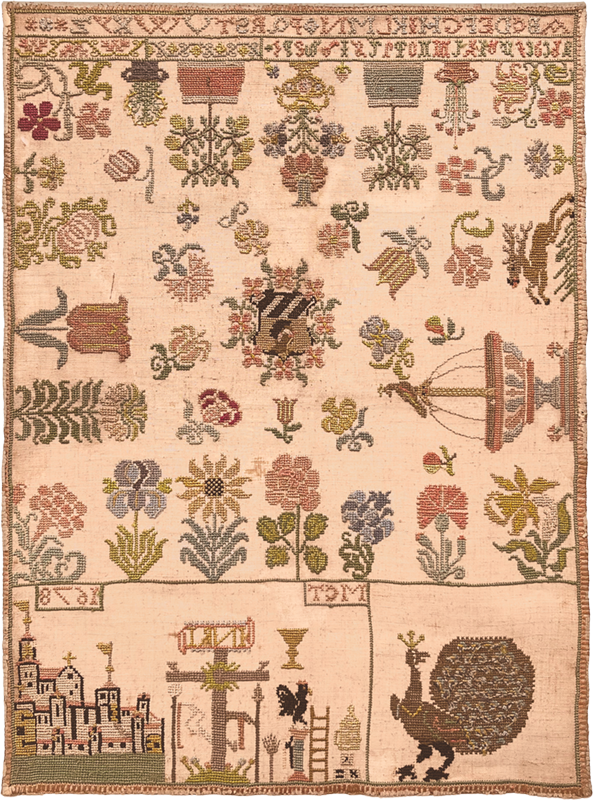
photo of reverse