
For much of the nineteenth century, whaling was one of America ’s major global industries. New England dominated whaling worldwide, with New Bedford its epicenter. The New Bedford Whaling Museum , with the world’s largest and most comprehensive collection related to whales and whaling, has been interpreting the history of whaling and its interrelated social and economic history since 1903. A new exhibition at the museum, entitled Needle/Work: Art, Craft, and Industry in a Port City, 1800–1930, provides an opportunity to explore, for the first time, the interrelationship of the whaling industry and needlework; domestic and commercial, utilitarian and decorative. It crafts a new understanding of how and where the worlds of consumption and production in the needle arts and trades overlapped and interconnected. In particular, it illustrates that the presumed distinctions between male and female practices were not always clear cut. From accomplishment and pastime to outwork and industry, this exhibition examines the roles that working with a needle played in the social, economic, and cultural lives of New Bedford ’s men and women during the preeminence of the whaling industry.
Why did needlework thrive here? From necessity and opportunity. Before consumer goods were mass-produced, young girls helped their mothers to sew and knit for the household. Men and women with needle skills stitched the sails that powered ships across the sea and crafted sailors’ clothing. A sailor’s skill with a needle was an important test of seamanship, and even inexperienced whalemen learned to make and mend for themselves. Whaling’s business elite patronized fine dressmaking, tailoring, and millinery shops. The wives and daughters of whaling entrepreneurs had the money and leisure to cultivate ornamental, as well as more common utilitarian skills. Whaling generated capital that funded new ventures, some in the needle trades, moving workers from home or cottage industries to factories. Immigrants to New Bedford brought their own traditional needlework skills, and found new employment opportunities. At the same time, leisure-time needlework became a symbol of refinement and gentility for a growing middle class, and a means of creative expression that cut across class lines.
Despite the community’s substantial Quaker population, fewer than a dozen of the known New Bedford samplers are associated with Quaker families and none of the samplers—plain or fancy—conforms to the style of cross-stitch samplers made at Quaker schools such as Westtown Boarding School in Chester County , Pennsylvania , or Nine Partners’ Boarding School in Dutchess County , New York . Only a handful of New Bedford samplers have any affinity at all with the Quaker style. One was completed in 1826 by Welthen S. Taber, whose family were members of the Society of Friends early in the Town’s history (fig. 1). Welthen’s third row of uppercase alphabets exemplifies the heavy Roman case lettering favored in Quaker schools. However, her crenellated border of strawberries is a fashionable addition found on samplers throughout antebellum America .
The New Bedford Academy , the first school in the town known to have taken girls was organized not by the Friends but by Congregationalists. Organized in 1797 by New Bedford merchants who lived on the Fairhaven side of the Acushnet River , the two-story school was completed in 1799; the first classes were held in 1800. Needlework and embroidery were not included in the basic tuition but were available for an additional charge. In 1812 Fairhaven was officially created as a separate town, and in May of that year the New Bedford Academy officially changed its name to Fairhaven Academy . In 1814, support for the school began to decline, likely because the region suffered heavy economic losses during the War of 1812. By 1816 the school was apparently no longer in operation; in August of that year the academy building was rented. It was sold at auction in 1841. Rebecca Nye was one of the first students to complete a sampler at the school after it changed its name to Fairhaven Academy in 1812. (fig. 2). Interestingly, she was already an adult of twenty-four and still living at home when she completed her embroidery.
In 1826 Mary Ann Jenney completed the only known mourning style sampler known from New Bedford or Fairhaven (fig. 3). It is unusual in not being dedicated to a particular person. Mary may have been unwell and had herself in mind, for she died just four years after completing the embroidery. The Jenneys were members of the Fairhaven Congregational Church.
Kathleen Staples
Consulting Curator
Madelyn Shaw
Vice-President of Collections and Exhibitions
New Bedford Whaling Museum
18 Johnny Cake Hill
New Bedford , MA 02740
508-997-0046
www.whalingmuseum.org
The exhibition runs through December 31, 2008; please visit their website for further information.
A sampler catalog is available from the museum for $19.95.
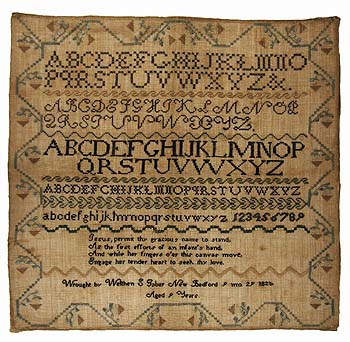
Figure 1.
Sampler by Welthen Taber (1817–1907), age 9
New Bedford , dated September 29, 1826
Silk thread; linen ground of 28 x 29 threads per in.
1992.47; Old Dartmouth Historical Society purchase
Photograph by Herb Andrew
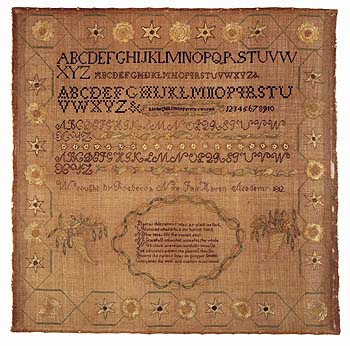
Figure 2.
Sampler by Rebecca Nye (1788–1867)
Fair Haven Academy , dated 1812
Silk thread; linen ground of 29 x 30 threads per in.
1999.36.108; Gift of Anne Fitch
Photograph by Herb Andrew
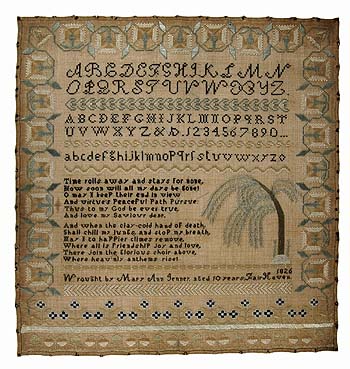
Figure 3.
Sampler by Mary Ann Jenney (1815–1830), age 10
Fairhaven , dated 1826
Two-ply and crinkled silk threads; linen ground of 29 x 30 threads per in.
2005.50.1; Old Dartmouth Historical Society purchase
Photograph by Herb Andrew